

BY JENNIFER CAMPBELL

WHY ARE DOWNTOWNS IMPORTANT? It’s a question CAPITAL put to Alain Miguelez, Vice President of Capital Planning and Chief Planning Officer at the National Capital Commission.
“I think the best way to answer that question is to compare the importance of a heart to a human body,” Miguelez says. “It’s as simple as that. The heart is what pumps blood through the entire body—through veins and arteries—and you want to make sure that those arteries are not clogged, and you want to make sure that the heart is healthy, so that the entire body is sustained.”
Miguelez says when it comes to the importance of downtowns to the whole city, downtowns play an important economic role. Building prices are highest downtown, which means higher property assessments and therefore higher contributions to municipal coffers. And, downtowns are also where residential tax revenue would be highest because of the density of multistorey buildings downtown.

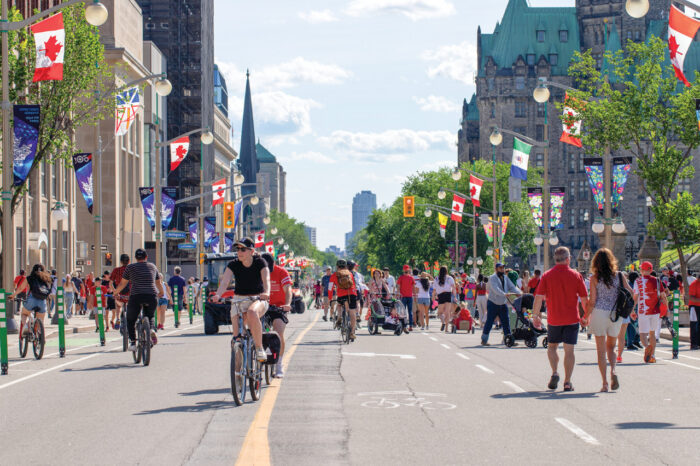
“They would be taxed at a much higher rate per acre of land than anywhere else in the city,” Miguelez says. “And then if you think about it symbolically, the downtown belongs to the entire city. It is the postcard of the city. It is how the city is identified internationally and nationally. It’s where you go to find the most diverse and wide range of activities—from the cultural to the economic to employment. And then there’s the nightlife, entertainment—just the bustle on the streets. It’s where the action is and it’s always been identified that way.”
Mary Rowe, CEO of the Canadian Urban Institute, would agree.
“All the economic opportunity that exists starts in the downtown,” Rowe says. “If you think about it, a city is an intersection of commercial, social—and, historically, of religious life. It all happened at a key intersection, which is what a downtown is.”
She says downtowns are like a magnetic polar influence of where it all happens.
“Trees grow from roots, plants grow from roots, gardens grow from the soil,” she says. “And cities are exactly the same. They mimic nature in that way. So, the adage I always say is that an apple rots from the core. You have to pay attention to what’s going on. You can’t ignore the central stem of a plant of any kind and the same is true for downtowns.”
Why Downtown Ottawa is Important
Canada is a vast land whose economic fortunes rest on the wise stewardship of its natural resources and civic assets and its ability to innovate, retain and recruit talent. Ottawa is well positioned to do all of the aforementioned. And because of its size, it’s already an important asset to the country. Ottawa-Gatineau is one of the country’s six economic regions, which, together, generate more than 65 percent of the country’s GDP. And downtowns account for 60 percent of the country’s GDP.
As a region, the National Capital attracts millions of tourists every year. Why? Because it’s the seat of the country’s most dominant brands—the Centre Block and the Maple Leaf—and it’s home to some of its most important and dynamic cultural institutions, including its six national museums.
As “A Living Capital: Investing in Downtown Ottawa for a Dynamic Future” states, “There is no benefit to pitting one part of the city against another: Making great cities is not a zero-sum game. For Canadian regions, it’s never a case of either-or, but always both-and.”
Sueling Ching, president and CEO of the Ottawa Board of Trade, agrees, saying the downtown is the heart of the city and also its economic engine. As a member of the Downtown Ottawa Champions Table, she says city leaders are committed to the downtown’s revitalization, which is “essential for Ottawa’s well-being and livelihood.”
Revitalization Efforts
The Canadian Urban Institute, which created the “A Living Capital” document in conjunction with the Ottawa Board of Trade, says cities need to connect people and place to reach their potential.
“Ottawa is uniquely rich with natural, human and built-form assets,” it states in the document. “We need to invest in all three: more people, better places, and the policies and programs to realize our collective goals. There is no time to squander what we have by idly waiting.”
Melissa Reeves, COO of Linebox Studio architectural firm, and another member of the Downtown Ottawa Champions Table, says the city centre should be world-class. “Right now, it’s difficult to put us up against Tokyo and Berlin and London and Paris, but it’s not to say that we can’t be there,” Reeves says. “We have all of the foundational elements needed to elevate Ottawa to become a true G7 capital city, but we need to make big, bold moves in order to do so.”
Those bold moves are outlined in the Downtown Ottawa Action Agenda, completed in May 2024. It notes that “the state of Ottawa’s downtown is the single most significant shift in our local economic landscape to ever happen.” Further, it says that improving the downtown requires an action-oriented, collaborative, multi-faceted approach. The plan came together with the help of key stakeholders in the National Capital Region and it includes ambitious but achievable measurable outcomes, which are all listed on livingcapitalottawa.ca, and they are updated as the work progresses on each.
The “make downtown Ottawa more desirable” outcome includes plenty of initiatives, such as identifying federal, provincial and municipal lands for affordable and supportive housing; identifying alternative funding sources to incentivize high-density residential development and purpose-built rentals; reviewing height restrictions for greater residential density; revising the federal disposal policy; among others. Those just listed are marked as “in progress.” The website also features news updates that are relevant to each outcome. For this one, those include the opening of a new luxury apartment building at the corners of Albert and Lyon streets; the establishment of a Food Basics grocery store on Queen and Lyon streets, and the deal between the Senators and the NCC to buy land for a new arena.
On making downtown Ottawa more resilient, there are calls for more public realm improvements, building better, more reliable public transit; supporting mobility links between downtown Ottawa and downtown Gatineau; converting some one-way streets to two-way, and expanding the city’s mural program to add light and colour to blank walls. Some concrete outcomes include a $56-million cash injection for upgrades and renovations to the Delta and Westin hotels; the Downtown Business Improvement Area’s new Metcalfe Plaza, an outdoor space that offered free shows and social activities this summer during a six-week pilot; and Live Nation’s investment in a 2,000-person music venue in the old Chapters building on the corners of Rideau Street and Sussex Drive. The latter will open in early 2026.

To make downtown Ottawa more robust, the Action Agenda recommends establishing a downtown cultural and arts district with branding and promotion; organizing recurring arts-related programs to bring people downtown in the evenings and off-season; implementing and amplifying the Nightlife Economic Strategy; among others. Outcomes so far in the “make downtown Ottawa more robust” category include Ottawa being selected for a new NATO defence innovation hub, and the Nightlife Commissioner’s launch of the Ottawa at Night website, which is a directory of venues that offer “attractions at night.”

Efforts to make downtown Ottawa more inclusive include making sure the Housing and Homelessness Leadership Table is the governance structure that drives Ottawa’s housing and homelessness strategy; supporting the implementation of traffic-calming and accessibility measures, and adopting the Crime Prevention through Environmental Design standard, which includes street lighting, parkade entrances, among other things. To this end, the Ottawa Police established CAMSafe, which aims to enhance crime prevention by leveraging community security cameras. Further, as part of an initiative led by the Indigenous Police Chiefs of Ontario, a group of 14 Indigenous youth from across the province visited the Elgin Street Police Station and Parliament, where they received a tour of Ottawa Police’s Parliamentary District Unit.
The Future of Downtown
Reeves says the asset mix in downtown Ottawa has never been balanced as it’s always been overburdened by federal offices.
“We often say in our office that COVID really just exposed the underlying issues that had always been there, which is the over-concentration of office spaces in downtown Ottawa,” Reeves says. “What that means is that when people are not at work, there’s nobody downtown. And so, in order to create a community and interest and just an amazing energy and vibe, you need to have people there, not just in the regular working hours.”
Reeves points to a recent Abacus Data public opinion poll, housed at LivingCapitalOttawa.ca, that found that most respondents feel that making downtown more attractive to visitors is important for the overall health of the city. A full 39 percent said it was “extremely important” and 49 more called it “important” for an overall total of 87 percent.
“From an urban planning perspective, we need to figure out what we’re going to do in order to draw people in, make big, bold moves and to aim high and not be afraid of designing things and planning things that are interesting and fun and engaging, and that will bring people into the city,” Reeves says, adding that amenities that are fun—and beautiful—are what give people a sense of community and joy and engagement with their city.

Trending Now
The OBOT Perspective