

By Jennifer Campbell
“Team Yes” became a catch phrase first used by Artificial Intelligence and Digital Innovation Minister Evan Solomon at this year’s City Building Summit. Mayor Mark Sutcliffe then used it in his remarks.
“There are a lot of critics out there,” Sutcliffe told the sold-out crowd. “It’s very easy, as Evan said, to dump on Ottawa. It’s very easy to talk about what’s not working. All I would ask of those people is they just move out of the way and make room for the people who are actually getting it done. And that’s all of you who show up all the time at events like this and every day in our community.”
The mayor talked about how far things have come since the end of the pandemic, after the convoy.
“Our downtown was struggling; our light rail system was the subject of a public inquiry; we had a shortage of police officers and paramedics … there was a real sense that things were moving in the wrong direction,” he said. “Four years later, we still have a lot to do, but we are back on the right track. We have built strong working relationships with our Liberal government on Parliament Hill and our Progressive Conservative government at Queen’s Park.”
He says those relationships have led to billions of dollars of investment and deals such as the LRT upload to the province, which will give the city $85 million a year to reinvest in more reliable public transit, and the agreement with Build Canada Homes. The city has also recently purchased 300 electric buses.
The mayor said the city is making significant progress on housing, affordability, transit, transportation and public safety while also building a stronger and more resilient economy and creating jobs.
Downtown Revitalization
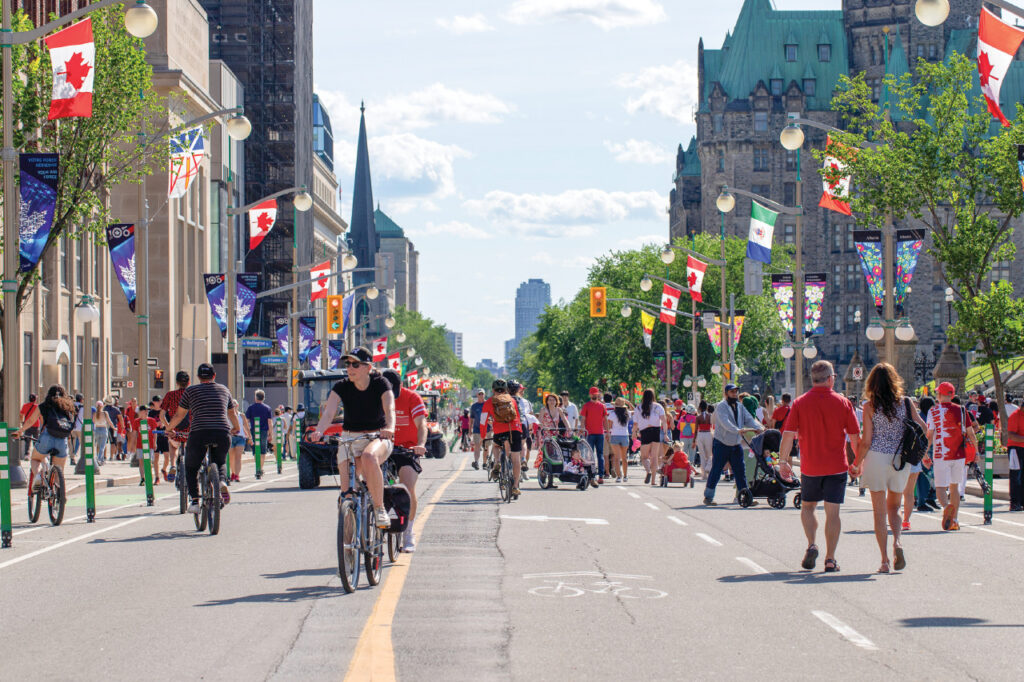
Sutcliffe noted that the city has recently launched the ByWard Market action plan and that visitor traffic was up 50% last year over the previous year.
“We’ve also just approved our new downtown action plan,” he said, adding that the federal employees back-to-the-office mandate will help downtown Ottawa.
He acknowledged that public safety is a critical part of downtown revitalization and the city has opened a new police operation centre to serve the ByWard Market and hired dozens of new police officers.
Sutcliffe also spoke about Anchor, which sends crisis workers to calls involving mental health and substance use. He called it a more compassionate response that means police resources are now freed up for other work.
He said the city is working hard to address the root causes of homelessness and other social challenges and provide more support for the most vulnerable.
“As you know, I made a pledge about six months ago to end youth homelessness in Ottawa by 2030, and we’re already starting to make some progress toward that goal.”
Owning the Future
Titled Capital 200: Owning our Future, the summit brought together city-builders, policy-makers, business leaders and community advocates for an inclusive and forward-looking conversation about the opportunities and challenges that will define the next century (the 200 refers to the 200th anniversary of the city’s founding).
MPs Mona Fortier and Yasir Naqvi, National Capital Region caucus members, spoke about their work.
Fortier said her job involves working with the province, the city and partners such as Invest Ottawa, Ottawa Tourism and the Ottawa Board of Trade. It also means investing in innovation, supporting federal procurement opportunities in defence and high-tech and attracting global talent as well as backing transformational projects such as the Live Nation Ottawa music venue in the ByWard Market.
“Projects like this create jobs, support local business and help make downtown Ottawa a destination, not just for work, but for culture, nightlife and community life,” she said.
Naqvi said Ottawans need to be able to afford to live in the city in which they work, which is why the federal government is investing so much in housing.
“Just last week the prime minister along with the mayor announced a deal to build over 1,100 homes as part of a larger agreement to build 3,000 [homes in Ottawa],” he said, adding that the new Build Communities Strong fund is investing in housing, enabling infrastructure and reducing municipal development charges.
Naqvi also mentioned the Alto speed rail project and the development of LeBreton Flats and the future home of the Ottawa Senators as important infrastructure projects.
Is AI a Threat or Opportunity?
The AI panel tackled the question of threat or opportunity, and tried to offer some actionable insights on next moves.
“It’s never been cheaper to start a company,” said panel moderator Sacha Gera, CEO of HEALWELL AI Inc.
On the question of whether it’s a threat or opportunity, Stephen Harrington, partner in human capital at Deloitte, said that the speed limit for AI is human and the fact that 93% of global spend in AI is on the technology side while only 7% is on the human side will have to change for it to be successful.
“One of the things we need to think about is how much we are going to use this tool for a substitution—simply replacing human endeavour with machine endeavour. [And we need to think about how much we are] going to co-design our future jobs with AI and humans working together for higher productivity?” Harrington asked.
Referencing Canada’s relative sluggishness in diffusing AI, Matthew Milton, president of Microsoft Canada, says he thinks there’s been too much focus on individual productivity.
“That generates anxiety and a lack of inspiration, which has led to organizations large and small being tentative to deploy it,” Milton says. “You have to get it into the hands of your people and train them to be confident using it because there are already wonderful success stories in this country. People are using it to fight forest fires, people are using it to combat doctor burnout. People are using AI right here in Ottawa to help kids in mental health crisis.”
Neilda Pacquing Gagné, chief ecosystem officer at AGI Ventures Canada, talked about AI Tinkerers, a group she co-founded. AI Tinkerers now has a network of 1,700 builders who gather to learn, play, test boundaries and share knowledge.
The University of Ottawa is training students in AI, but also in its ethics, said Marie-Eve Sylvestre, president and vice-chancellor at the University of Ottawa. “We feel an important responsibility when it comes to AI.”
The Growth Imperative
“We have heard throughout the morning about this period of growth,” said Jennifer Cross, director of regional development at Chandos Construction. “That growth is real, it’s visible, and it’s happening across housing, infrastructure, connectivity and major capital projects, but it raises a fundamental question: Are we building fast enough? Because growth on its own is not success. Delivery is, and delivery means land is ready, infrastructure keeps pace, projects move forward with clarity and confidence, and the public and private sectors are aligned in how we get there.”
Susan Margles, president and CEO of the Ottawa International Airport Authority, talked about the new Alt Hotel that’s connected to the airport as well as three transatlantic routes to Paris, London-Heathrow and London-Gatwick.
Hugh Gorman, CEO of Colonnade BridgePort, says his home-building firm has about $2 billion in development to come and $500 million under construction now, with another two projects and 1,000 units coming online this year. He says the problem in Ottawa is not a lack of infrastructure, but a lack of capital.
Mark Goudie, president and CEO of Ottawa Sports and Entertainment Group, says Lansdowne has been reclaimed. It attracts four million visitors each year, up from 250,000 before it was redeveloped.
Linda Jenkyn, a director general at Public Services and Procurement Canada, says the federal government has an important role to play in the development of the capital. She says the return-to-office mandate will have a significant impact downtown. Considerations for her include security, heritage and Indigenous engagement and relations.
“The federal government isn’t a passive player in the city and we shouldn’t be,” Jenkyn said.
Gorman said there is no lack of ambition in Ottawa, but the work is happening in silos.
Goudie said the downtown action plan is great, but “how do we get more people pulling on that rope to fix downtown?”
Asked for one bold move, Margles said it’s time to “get out of our comfort zone.”
Fireside Lessons from Global Capitals
Mary Rowe, president and CEO of the Canadian Urban Institute, hosted a session on the evolution of capital cities, focusing on Ottawa, Washington, D.C., and London, England. Tracy Hadden Loh, a fellow at Washington’s Brookings Metro, highlighted the impact of federal job downsizing, leading to a 30% office vacancy rate and a 15% drop in resident spending. Ruth Duston, founder and CEO of Primera Corporation in London, emphasized the role of business improvement districts (BIDs) in collaborative city-building, citing a 30,000 footfall increase from events, and Tobi Nussbaum, president and CEO of the National Capital Commission shared initiatives such as the Dow’s Lake swimming dock, which saw over 100,000 visitors, and plans for more swimming docks at the bottom of the Rideau Canal locks and outside the Museum of History.
Hadden Loh offered a cautionary tale, saying that the 90% of people in D.C.’s labour market who didn’t work for the federal government were still affected by the cuts.
Duston said London has seen the impact of hybrid working, vacancies at the ground floor level and a big reduction in public-sector funding.
Nussbaum talked about the National Capital Commission’s efforts to “turn toward the water” in Ottawa. ”
And all of this really [is] in the service of the themes of this conference of city-building, of animation, of showing off Canada’s capital proudly, and really trying to demonstrate that Ottawa, as a symbol of Canada, can be ambitious in its implementation,” Nussbaum said.
The panel stressed the importance of collaboration, agility and innovative approaches in city development.
Defence and Sovereign Innovation
Following Defence Minister David McGuinty’s keynote address, Sonya Shorey, president and CEO of Invest Ottawa, moderated the panel on defence and sovereign innovation and talked with passion about Ottawa’s assets, including its 130-plus embassies, 25 defence attachés and 330 defence, aerospace, security and cyber-security companies, among other strengths.
Shorey also talked about the potential for Ottawa to be the headquarters of the global Defence, Security and Resilience Bank. Canada was recently announced as the headquarters of the bank that could eventually bring together as many as 40 NATO nations and will bring 3,500 defence jobs to the winning Canadian city.
“Ottawa-Gatineau is the only place it should be anchored,” Shorey said.
Joining the panel were Josh Ogden, CEO and Co-founder of AVSS; Jordan Freed, president and managing director at Kongsberg Geospatial; Chris Pogue, president of defence and space at Calian and Samuel Witherspoon, CEO of ANVIL.
“I think that we’ve lived on a very safe island with a very historically safe and friendly neighbour,” said Witherspoon. “That has shifted, and I think it’s really sort of brought into focus why defence and sovereign capability is suddenly so important for us as a country.”
Witherspoon added that he has 25 job postings for 70 people, but housing affordability and transit “kinda suck” and that’s hampering attracting new talent to the city.
“They need transit and affordable housing and we’re at the city-building summit and those are problems that this room is working on,” he said. “Please help me.”
All of the panellists said they want to help the ecosystem grow.
Ogden said if you’re gunning for 100% perfection, you’re wasting too much money on accounts and finance people.
“Anyone who’s coming into the innovation space who thinks that every hit is going to be a home run is wrong,” Ogden said.
Energy Readiness
Geoff Wright, senior vice-president of development at Brookfield Renewable, moderated a panel on energy and infrastructure leading to productivity. The panel featured Julie Lupinacci, executive vice-president at Hydro Ottawa; Scott Demark, partner at Theia Partners; Chuck Farmer, executive vice-president at Independent Electricity System Operator, which manages Ontario’s power grid; and Terry Young, president at KRP Properties.
Farmer said his job is to make sure that the power system “can be operated reliably and affordably, not only today, but well into the future.”
Lupinacci said she’s seeing massive growth and that comes with challenges as energy is being used in a very different way today.
Demark said his company does vertical and real estate development that is commercial and residential as its goal is to have as few emissions as possible for these projects.
Terry Young, who manages a Kanata technology park, says clients are asking for technology that he can’t provide. “We’re pushing the maximum capacity of the grid,” Young said.
The mayor probably best summed up the common sentiment in the room at the end of his remarks when he said: “I believe for Ottawa the best is yet to come.”